The Performance Optimizer: Inside Anne Walker's Stanford Dynasty
Stanford's winningest coach treats every player like a founder — and thinks college golf's real problem isn't NIL, it's the calendar.
Mollie Cahillane
mollie@bigswingmedia.news
Anne Walker doesn't call herself a head coach. Instead, she’s a performance optimizer.
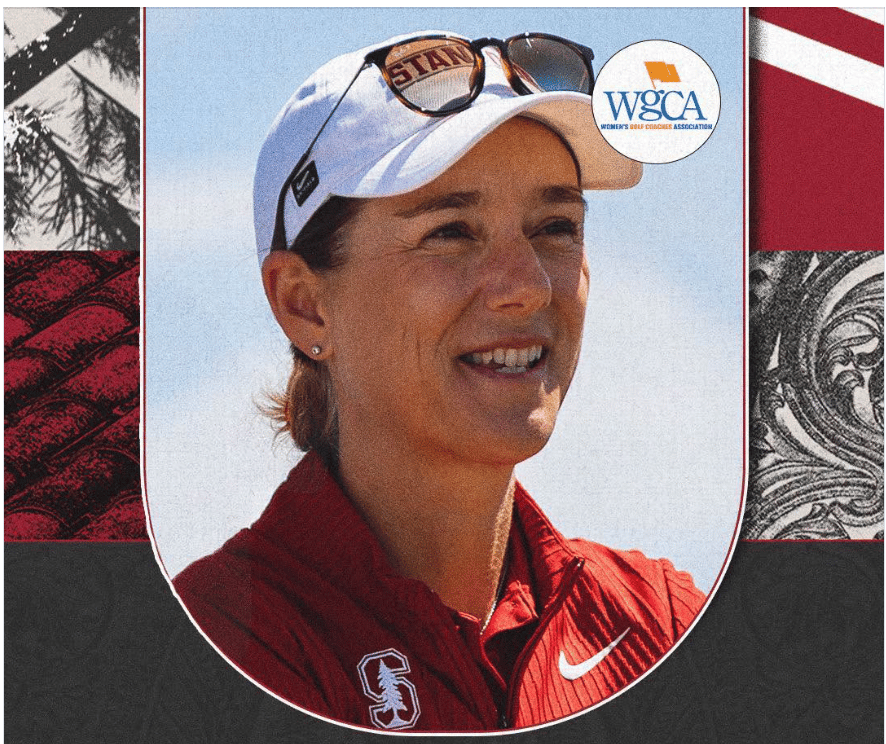
That distinction matters to the four-time Jackie Steinmann WGCA National Coach of the Year. In an upcoming conversation on The Big Swing with Jimmy Roberts, the Stanford women's golf coach laid out a management philosophy that looks less like a playbook and more like an operating system, built for a roster of nine women who are some of the best golfers in the world, and who Walker treats as nine separate businesses.
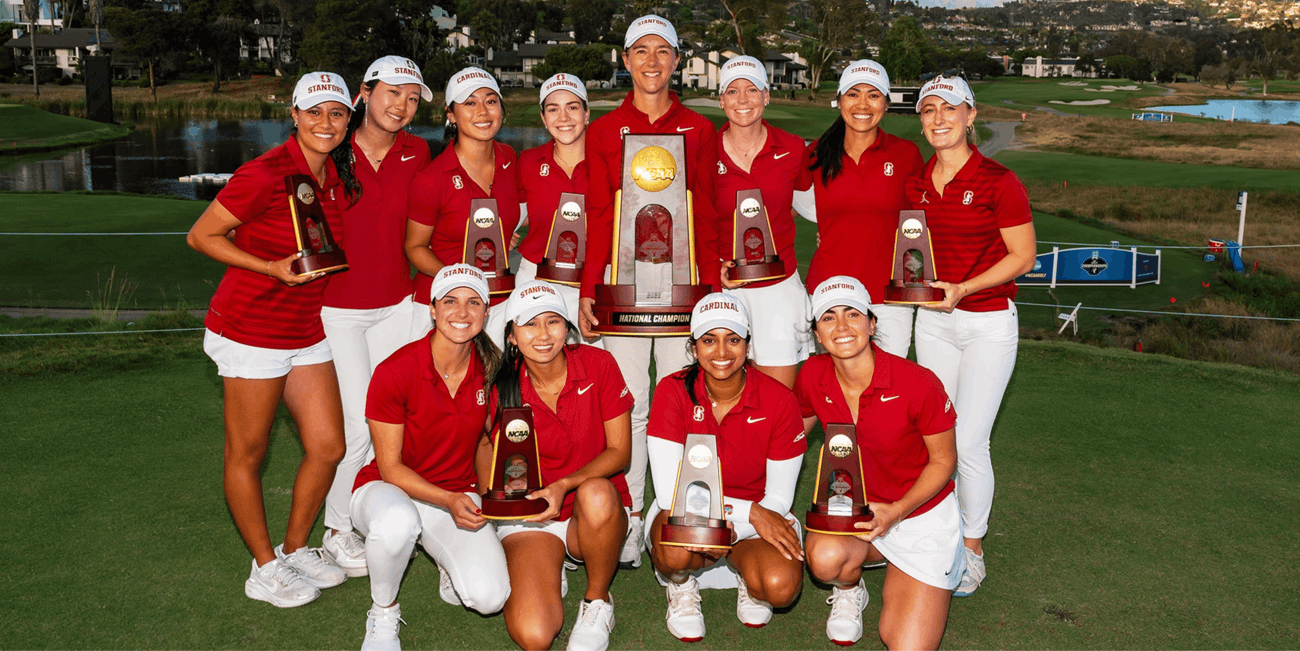
Her team just finished a season that may be Walker’s best yet: no losses in stroke play and a perfect run through match play at both the conference championship and the NCAAs. But ask her why, and she doesn't point to swing mechanics. She credits infrastructure — a 22-acre practice facility, Stanford's brand pull, and a coaching philosophy that treats golf as one slice of a much bigger pie. "There's no limits," she told Roberts. "You can be as good as you want to be here."
The CEO Framework
Walker's central metaphor is corporate, and she uses it deliberately. Every player, she tells her team, is the CEO of her own company. Coaches, parents and teammates are advisors around the boardroom table — voices that inform decisions, but never make it.
"One of the things we're always talking about within our team is you are the CEO of your company. You are a brand," Walker said. "As the CEO, you get to decide who are the advisors that you put around your board table. You're the one that decides: okay, this is the direction we go. For most of these athletes, it's the first time they are doing that. Prior to that, parents typically have been the ones pulling the levers.”
Most of Walker's players are encountering independence for the first time, and the identity questions that come with it: which of their parents' values are actually theirs, and which were just inherited. "You've spent your entire life living through the values and the identities of your parents and your family unit," she said. "And then you get to college and it's the first time you really get to explore ‘who am I?’ at the core."
A Model Inherited
Walker credits her own college coach at the University of California, Berkeley, the late Mary McDaniel, with shaping how she leads now. McDaniel recruited her out of Scotland, gave her her first coaching job the Monday after she graduated, and remained a guiding presence until her passing from breast cancer two years ago. "She was very people first," Walker said. "I saw the impact of that, even with the players who maybe didn't make it to the top of our lineup, but she impacted their lives so much."
That influence is why Walker describes her own role in terms that go beyond golf. "Yes, I'm a golf coach," she said, "but also I'm a mentor, I'm a leader, I'm an educator. And it's a really, really privileged role I get to play in these young women's lives."
Two Different Sports
Walker shares a building with Stanford men's coach Conrad Ray, and 15 years of proximity has given her an unusually clear view into how differently the men's and women's games function. On the women's side, the top five or six juniors in a class tend to stay in the top five or six through college and into the pros. The men's development curve is far less linear. "The men develop physically a little bit later," she said. "They can grow eight to twelve inches in a year."
The psychological coaching differs too. "The guys don't need encouragement to compete," Walker said, "but the women, we're always reminding them that competition is not a bad thing."
Practice as Emotional Rehearsal
Ask Walker to describe a single practice day and she'll tell you the whole point is that no two days repeat. Her staff builds sessions around three data sources: match observation, real-time statistical tracking, and the player's own self-report — which, she notes, is often the least reliable of the three. "A player will say to you, 'I'm putting terribly, Coach,'" she said. "And then when you counter that with the real data and the observational data, it's just not accurate."
The drills are built to recreate pressure, not just technique — including a favorite where players race between six-foot par putts and twelve-foot birdie putts, trying to get to three-under before they go three-over. "All they're doing is recreating the emotions that we have on the golf course," Walker explained, "so that you can try to be more prepared when you get out on the golf course."
What She'd Fix
Walker isn't naive about the pressures reshaping her sport. NIL has already transformed her roster — Rachel Heck signed one of the first major deals in 2021 (with Nike), and Rose Zhang and Megha Ganne followed with their own, including AT&T and Adidas.
"I do think it's a wonderful thing when NIL is done right, let's just say, when it's implemented in the way it was designed to be implemented. I've been likening college sports this decade to a startup," she told Roberts. "We are right now a startup that is trying to act like a fifty billion dollar startup, but we're operating like a one million dollar startup. We're lean, we're mean, and we don't have any rules yet. But we will get there."
NIL isn’t her biggest concern, rather it's scheduling. The rise of elite amateur golf has been good for the sport, but it's also created a calendar with almost no room for rest, a problem Walker increasingly manages more like an agent than a coach. "It's shocking how quickly the entire season just — boom," she said. "There's very few windows for rest, recovery."
She doesn't sound worried about where any of it lands. Walker says she gets to spend her days with nine of the sharpest, most driven young women in the sport, and that alone makes her confident about golf's future — rules of the road or not.
|